
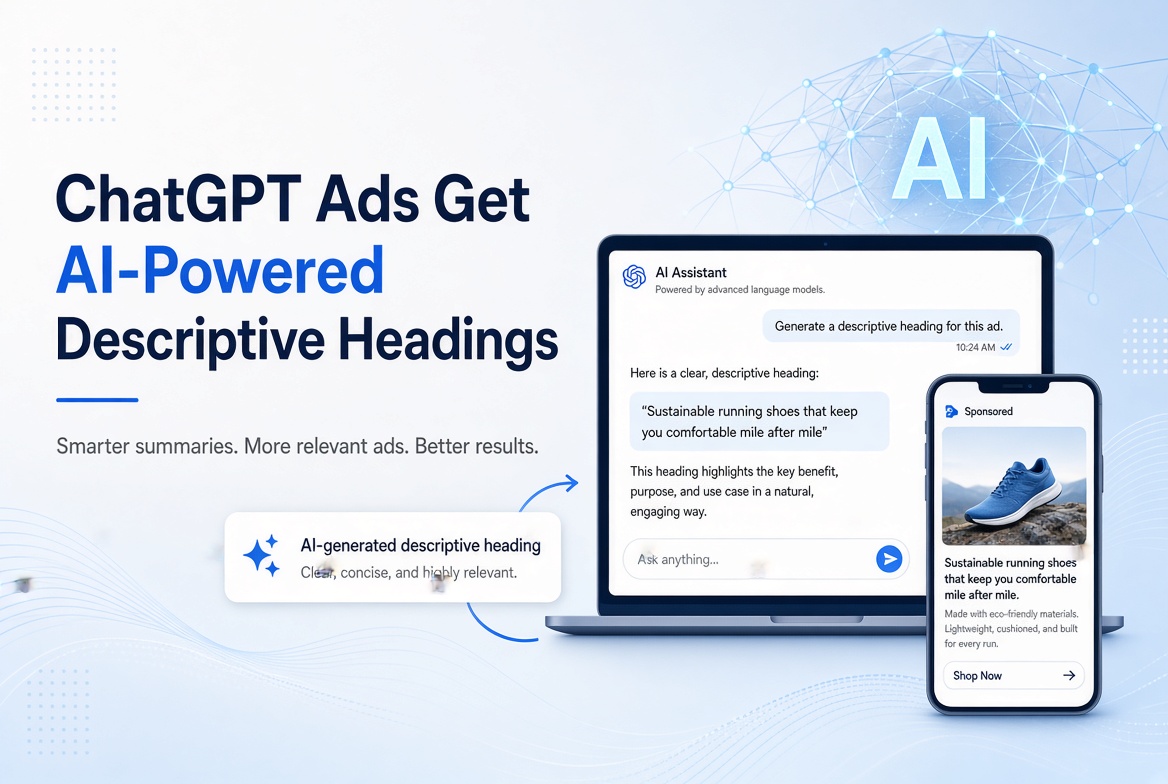
OpenAI continues refining how advertising appears inside ChatGPT. In mid-August 2026, users and industry observers noticed a new element in some ad placements: a short descriptive heading sitting directly above the sponsored unit. These headings appear designed to give extra context about why the ad is relevant to the ongoing conversation.
This change was first publicly noted by Brodie Clark, who shared screenshots showing the new layout. The headings read like natural summaries of the product or service being promoted and sit cleanly between ChatGPT’s organic answer and the labeled ad. Many assume OpenAI’s own models generate these lines on the fly to improve relevance and click-through potential.
The test builds on the broader ChatGPT ads program that began rolling out in February 2026. Ads appear only for logged-in adult users on the Free and Go plans. Paid tiers such as Plus, Pro, Business, and Enterprise remain ad-free. OpenAI has repeatedly emphasized that ads never influence the content of ChatGPT’s answers and that conversations stay private from advertisers.
How ChatGPT Ads Currently Work
ChatGPT ads sit below the AI response as clearly marked sponsored cards. Each unit typically includes the advertiser’s name, favicon, a short title, a brief description, a square image, and a link to a landing page. Matching relies on conversational context rather than traditional keywords. Advertisers supply “context hints”—natural-language descriptions of the topics or situations where their products fit—and the system decides relevance based on the current chat, past interactions (when personalization is enabled), and other signals.
Character limits are tight. Titles often fall in the 16–24 character range and descriptions in the 32–48 character range, forcing concise, benefit-focused copy. OpenAI has expanded the program to additional markets including the United Kingdom, Mexico, Brazil, Japan, and South Korea, while opening a self-serve Ads Manager that supports both CPM and CPC bidding.
The new descriptive headings represent an evolution of this format. Instead of relying solely on the advertiser-supplied title and description, the system adds an AI-written line above the ad. The goal appears to be stronger topical alignment and a more seamless user experience.
Parallels with Google’s Experiments
Google has run similar tests with AI-generated summaries or headlines for its own ads. In those cases, many advertisers expressed frustration. They invest time crafting precise messaging and prefer that Google display the exact copy they approved rather than machine-rewritten versions. Some worry that AI summaries can dilute brand voice, introduce inaccuracies, or shift emphasis away from the intended offer.
OpenAI’s approach may face the same feedback. Advertisers who carefully write headlines and descriptions may feel less control when an extra AI layer sits above their creative. At the same time, well-executed descriptive headings could improve relevance scores and performance metrics, especially in a conversational environment where context is richer than a simple search query.
Why This Matters for Publishers and AdSense-Focused Sites
Sites focused on blogging, SEO, and AdSense revenue (such as those in the AdSense family of content creators) should pay attention for several reasons.
First, ChatGPT is becoming a discovery channel. Users increasingly ask detailed questions instead of typing short search terms. When an ad appears with a clear, AI-generated heading that matches the conversation, it can feel more helpful than a traditional search ad. Publishers who also run advertising campaigns or promote affiliate offers may find new opportunities to appear in these high-intent moments.
Second, the rise of AI chat interfaces changes how traffic and monetization work. Some organic search volume is shifting toward conversational AI. Understanding how ads surface inside those experiences helps publishers diversify beyond classic AdSense placements. Brands that experiment early with ChatGPT ads can gather data on messaging that works in AI environments and later apply those insights to their own sites or Google Ads campaigns.
Third, the emphasis on context and usefulness aligns with long-standing AdSense best practices. High-quality, relevant content that answers real user questions still wins. When ChatGPT shows an ad with a descriptive heading that accurately reflects the conversation, it reinforces the idea that relevance drives results—whether the revenue comes from AdSense, affiliate links, or direct advertising.
Potential Benefits of AI Descriptive Headings
A well-written heading can serve as a bridge. It tells the user, in plain language, why the sponsored suggestion matters right now. In a long ChatGPT response about choosing a standing desk, an AI heading such as “Adjustable desks that fit small apartments” can make the ad feel like a natural next step rather than an interruption.
These headings may also help with performance. Better contextual framing can increase click-through rates, lower cost-per-click for advertisers who bid on CPC, and improve overall relevance signals for the platform. For OpenAI, stronger ad engagement supports the goal of funding free and low-cost access without compromising answer quality.
From a user-experience standpoint, the headings keep the sponsored content clearly separated while adding value. Users still see the “Sponsored” label and can choose to engage or ignore the ad.
Challenges and Concerns for Advertisers
Control remains the biggest issue. When AI rewrites or expands on advertiser copy, brand messaging can drift. A carefully positioned premium product might receive a heading that emphasizes price or convenience instead of quality. In regulated or sensitive categories, even small wording changes carry risk—though OpenAI already restricts ads near health, mental health, politics, and other sensitive topics.
Transparency is another question. Advertisers currently have limited visibility into the exact conversations where their ads appear. Adding AI-generated headings further distances them from the final presentation. Testing multiple creative variations becomes even more important so the system has strong options to work with.
Measurement and attribution also evolve. Because ads appear after a full conversational answer, the user already has substantial information. Click-through and conversion rates may differ from traditional search ads. Early campaigns suggest that clear, benefit-focused copy and strong landing-page alignment perform best.
Practical Tips for Marketers and Publishers
If you plan to test ChatGPT ads or simply want to prepare for the broader shift toward conversational advertising, consider these steps:
- Write context hints that sound like real user questions or situations rather than keyword lists.
- Create multiple title and description variations that highlight different benefits or use cases.
- Keep landing pages tightly aligned with the conversation topics you target.
- Monitor performance closely and be ready to adjust if AI headings alter how your offer is framed.
- For publishers, continue producing high-quality, answer-oriented content. The same principles that help content rank in search and perform well with AdSense also make it more likely to appear (or influence) AI responses.
- Experiment with first-party data audiences where available, and respect user privacy settings around personalization.
Staying informed about platform changes is essential. OpenAI has moved quickly from initial tests to self-serve access and international expansion. Further refinements to ad formats, including larger images, dynamic call-to-action buttons, and e-commerce-specific units, have already appeared in limited tests.
Looking Ahead
The introduction of AI descriptive headings is a small but telling signal. OpenAI is treating advertising as a core product feature rather than a simple monetization bolt-on. The company aims to keep ads useful and non-intrusive so that free and low-cost access remains sustainable.
For the wider digital marketing and publishing community, this development underscores a larger trend: advertising is moving deeper into AI-mediated experiences. Search ads, social ads, and now conversational ads all compete for attention at the moment of intent. Success will favor marketers who understand context, write clear value propositions, and respect the user’s trust.
Publishers who rely on AdSense and related revenue streams should view ChatGPT ads as both a competitive force and a learning opportunity. The same focus on relevance, user experience, and high-quality content that drives AdSense performance will help content creators adapt to an AI-first discovery landscape.
As testing continues, expect more iterations. Headings may become more personalized, formats may expand, and measurement tools will likely improve. Advertisers and publishers who watch these changes closely and test thoughtfully will be better positioned to thrive as conversational AI becomes a standard part of how people research, decide, and buy.
In short, the appearance of AI-generated descriptive headings above ChatGPT ads is more than a cosmetic tweak. It reflects OpenAI’s ongoing effort to balance user trust, advertiser results, and sustainable free access. For anyone building an online business around content, advertising, or affiliate marketing, understanding and adapting to these shifts is no longer optional—it is becoming essential.
