How Giving Away Free Ebooks Can Triple Your Daily AdSense Pageviews
Most AdSense publishers hit a wall. They chase keywords, publish steadily, and watch traffic rise—then stall. Pageviews stay flat. RPM refuses to climb. The problem is rarely “not enough traffic.” It is that the traffic behaves like a one-night stand: lands, glances, leaves.
Free ebooks change the math. When done correctly, they turn single-page visitors into multi-page sessions, email subscribers into repeat readers, and ordinary content into a high-RPM engine. This is not theory. It is a repeatable system used by niche publishers who quietly out-earn sites with ten times their raw traffic.
The Traffic Ceiling: Why Traditional SEO Alone Leaves AdSense Sites Vulnerable
Search traffic is rented. Google can change the ranking tomorrow. Even when rankings hold, most visitors treat your site like a drive-through. They solve one question and bounce. That single-page session is expensive for AdSense economics.
AdSense revenue is not just about impressions. It is about viewability, session depth, and the probability that a user sees multiple high-value ad units. A visitor who reads three pages generates more revenue than three visitors who each read one page—especially if those three pages sit in higher-RPM categories or carry better ad placements.
Single-page bounces kill RPM in two ways. First, they reduce the total number of ad impressions per visitor. Second, they signal low engagement to Google’s systems, which can affect both organic visibility and the quality of ads shown. Publishers who rely only on SEO live permanently under a traffic ceiling set by their average session duration and pages-per-session.
The free-ebook approach attacks that ceiling directly. Instead of hoping visitors stick around, you give them a structured reason to stay, click deeper, and return.
The Free Ebook Arbitrage: How the Mechanics Actually Work
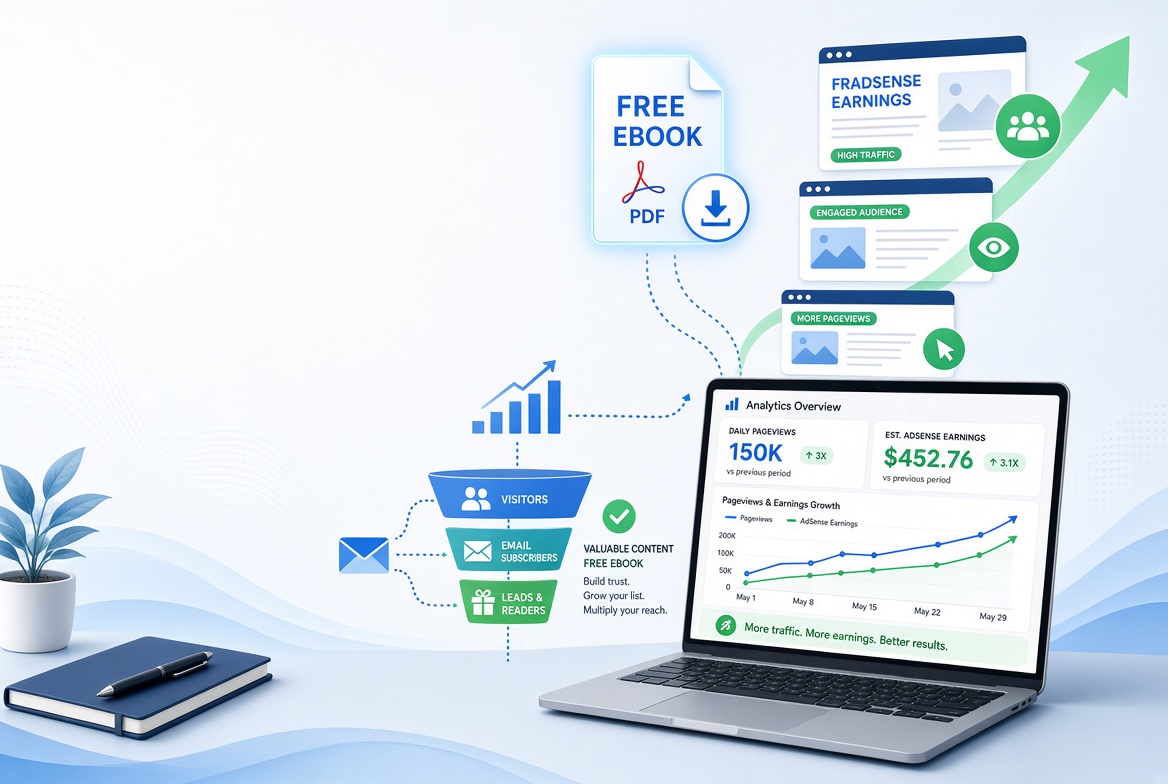
The core idea is simple: trade high-perceived-value content for attention and email permission, then systematically convert that permission into on-site pageviews.
Psychology does most of the heavy lifting. People still respond strongly to free, high-value resources that solve a specific pain. A well-titled 20-page guide feels more substantial than another blog post. The act of opting in creates a small commitment. That commitment raises the odds the person will actually consume the material—and consume it on your terms.
Here is the basic traffic multiplication sequence:
- Visitor lands on a blog post or landing page.
- Sees a clear offer for a free ebook that solves a painful, specific problem.
- Opts in (or clicks through to an on-site chapter).
- Lands on a delivery or hub page that contains ads and internal links.
- Reads chapters hosted as separate, ad-supported pages (or receives sequential emails that drive them back to those pages).
- Email sequences continue to send them to related high-RPM articles over the following weeks.
A modest example: 50 daily opt-ins. Each opt-in triggers an average of 4 additional pageviews across the first week (delivery page + 2–3 chapter or related-article views). That is 200 extra daily pageviews from the funnel alone—before counting future email traffic. For many mid-tier sites, that is enough to double or triple baseline pageviews once the system is running.
The arbitrage works because the cost of creating one solid ebook is fixed, while the pageviews it generates compound as the email list grows.
The Architecture of an AdSense-Optimized Ebook Funnel
Step 1: Crafting the Irresistible Bait
The ebook must solve one concrete problem for a specific audience. Vague titles underperform. Strong titles sound like this:
- “The 14-Day Keyword Research System for New Niche Sites”
- “How to Cut Your AdSense Policy Risk by 80% in One Afternoon”
- “The Exact Content Upgrade Checklist That Doubled My Pages-per-Session”
Aim for 15–30 pages. That length feels substantial without becoming a chore. Pull from existing long-form posts, expand them with case studies, screenshots, and checklists, then structure the material as sequential chapters.
Step 2: The On-Site Reader Method vs. Direct Download PDF
Direct PDF download is convenient but weak for AdSense. Once the file leaves your site, the session ends.
The stronger model hosts the content as a series of web pages:
- Landing/delivery page (thank-you + overview + first chapter teaser).
- Individual chapter pages, each with its own URL, internal links, and ad units.
- Optional printable PDF version offered at the end or via email.
This keeps the reader inside your monetized environment. Each chapter becomes a separate pageview opportunity. Readers who prefer offline reading still get the PDF; the rest generate the pageviews that matter.
Step 3: Strategic Internal Linking & Contextual Anchor Distribution
Every chapter page should contain 3–5 contextual links to related high-RPM articles on your site. Use natural anchors that match search intent (“see the full ad-placement study” rather than “click here”).
Place the strongest internal links after the reader has consumed value—mid-to-late in the chapter—when engagement is highest. The goal is not to trap people; it is to make the next logical step obvious and low-friction.
Email List Integration as a Pageview Multiplier
The ebook is the entry point. The email list is the multiplier.
Build a short onboarding sequence (5–7 emails over 10–14 days):
- Email 1: Delivery + quick win from Chapter 1 + link back to the full chapter page.
- Emails 2–4: One key insight per email + link to the corresponding chapter or a related deep-dive article.
- Emails 5–7: Case studies, advanced tips, and links to your highest-RPM content clusters.
Segmentation matters. Tag subscribers by the specific ebook they requested. Send future broadcasts that match that interest. A subscriber who downloaded a keyword-research guide responds better to traffic and content strategy emails than to a generic “here’s my latest post” blast.
Well-run lists routinely achieve 15–30% open rates and 3–8% click-through rates on broadcast emails. Even at the low end, a 2,000-subscriber list can drive hundreds of additional daily pageviews when you send 2–3 targeted emails per week.
Ad Placement & UX Balancing: Maximizing RPM Without Penalties
Google’s policies still apply. Aggressive or misleading placements get sites restricted or banned. The safe, high-performing approach focuses on viewability and natural reading flow.
High-performing zones on ebook hub and chapter pages:
- In-feed units that blend with chapter navigation or related-content blocks.
- Sticky anchor ads (bottom or side, depending on layout) that remain visible without covering content.
- Mid-content breaks after major sections—never right after the headline or before any real value.
Respect Core Web Vitals. Large image-heavy PDFs or unoptimized chapter pages destroy mobile experience and can hurt rankings. Keep pages light, use lazy loading for images, and test ad density with real users. A reader who bounces because the page feels spammy generates zero long-term value.
Track pages-per-session and session duration on the ebook section separately. If those metrics rise while overall RPM climbs, the balance is working.
Real-World Implementation Blueprint: 7-Day Launch Plan
Day 1–2: Choose the topic from your top-performing content cluster. Outline 5–7 chapters. Pull existing posts and expand them.
Day 3: Write or assemble the chapters. Create a simple cover graphic and chapter graphics if needed. Keep design clean and fast-loading.
Day 4: Build the delivery/hub page and individual chapter pages. Insert internal links and ad units. Set up the opt-in form (or make the first chapter free and ungated if preferred).
Day 5: Write the 5–7 email onboarding sequence. Connect it to your email platform so the sequence starts on opt-in.
Day 6: Soft-launch. Promote the ebook inside 3–5 of your highest-traffic related posts using content upgrades or end-of-post offers. Announce it to your existing email list.
Day 7: Expand promotion. Share in relevant niche communities, forums, and social channels where the audience already gathers. Focus on value first—“I put together a free guide that walks through X”—rather than pure promotion.
Track opt-ins, delivery-page pageviews, chapter completion rates (via analytics), and email click rates. Adjust the next iteration based on real data.
Common Pitfalls to Avoid
- Gating everything too aggressively. Some publishers require an email for every chapter. That kills momentum. Give real value first.
- Slow or broken delivery. A delayed or missing ebook destroys trust and tanks future conversion rates.
- Low-effort “ebooks.” Thin 5-page PDFs with no new insight underperform and can damage your brand.
- Misleading triggers. Promising one thing and delivering another violates both user trust and AdSense policies.
- Ignoring mobile experience. Most traffic is mobile. Test the entire funnel on phones.
- No follow-up system. An ebook without an email sequence is a one-time traffic spike, not a compounding asset.
Long-Term Scaling & Multi-Funnel Expansion
Once the first ebook performs, treat it as a template. Repurpose clusters of related long-form posts into additional themed guides. Each new ebook feeds the same email list and creates new entry points.
Over time you can build a small library: one guide for beginners, one for intermediate practitioners, one focused on a specific tactic. Cross-promote inside each other. Segment the list more finely. The result is a self-reinforcing system where every new piece of content has multiple paths to drive pageviews—organic search, internal links from the ebook library, and ongoing email traffic.
Publishers who execute this consistently stop living at the mercy of algorithm updates. They own a growing audience that returns, reads deeper, and generates higher daily AdSense pageviews without proportional increases in content output.
The free ebook is not a traffic hack. It is a shift from renting attention to owning a relationship that keeps producing pageviews long after the original click.