I’ve spent more than a decade testing SEO tools for clients and my own sites. Premium platforms like Ahrefs and SEMrush deliver deep data, but the monthly bills add up fast. That is why so many people land on Neil Patel Ubersuggest and start searching for an honest Ubersuggest review. The promise is simple: solid keyword research and site insights at a fraction of the cost. The reality is more mixed.
This Ubersuggest review cuts through the marketing. I will tell you exactly where the tool shines, where the data falls short, and who should actually pay for it.
The Quick Verdict
Is Ubersuggest worth it?
Yes — if you are a beginner, solo blogger, or small business owner who needs a practical free keyword research tool and can live with imperfect data.
No — if you run an agency, need accurate long-tail volumes, deep backlink analysis, or daily rank tracking. In those cases the cheaper price becomes expensive when the data misleads you.
For most people just starting out, it remains one of the better SEO tools for beginners.
Pros and Cons at a Glance
| The Good | The Bad |
|---|---|
| Very affordable (and lifetime options) | Search volume often weaker on long-tail terms |
| Extremely easy interface | SEO Difficulty is a rough estimate only |
| Useful free plan + Chrome extension | Backlink index is shallow |
| Solid keyword ideas and content ideas | Rank tracking updates only weekly |
| Good enough for basic site audits | Limits get tight once you scale |
What is Ubersuggest?
Ubersuggest started as a simple free keyword suggestion tool. Neil Patel later bought it and turned it into a broader SEO platform. Today it covers keyword research, site audits, basic backlink checks, rank tracking, and content ideas. The positioning is clear: an accessible Ahrefs alternative for people who cannot or will not pay $100–$200 a month.
It is not trying to replace the heavyweights. It is trying to be the tool you actually open every week because it does not intimidate you.
Key Features
Keyword Research
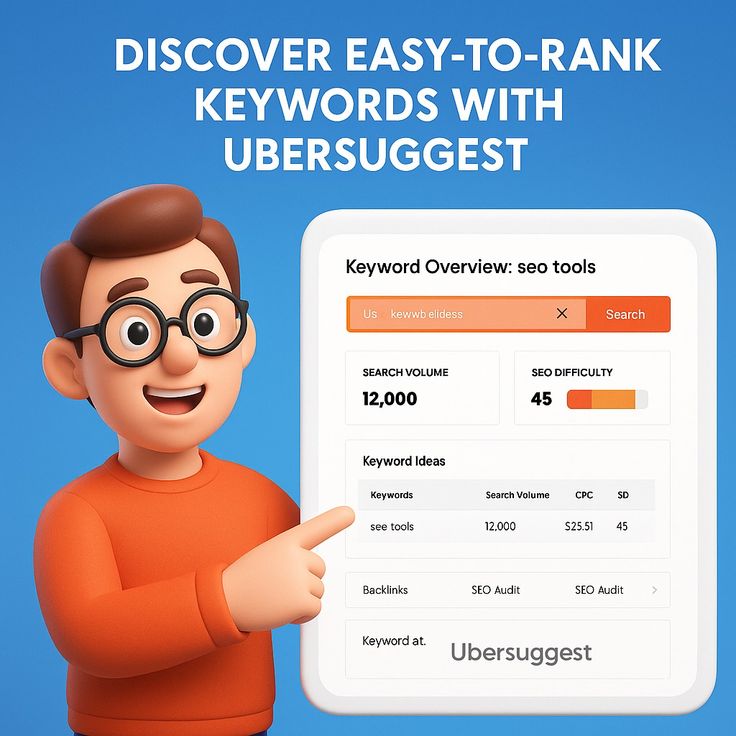
This is still the strongest part of any Ubersuggest review. Enter a seed keyword and you get volume estimates, SEO Difficulty, paid difficulty, CPC, related ideas, questions, and content suggestions. The Keyword Ideas report is practical for building content calendars quickly. I have used it to surface dozens of usable long-tail opportunities in a single session.
Site Audit
The site audit crawls your pages and flags common technical issues — missing titles, slow pages, broken links, and basic on-page problems. It is not as thorough as Screaming Frog or the premium tools, but it is clear and actionable for smaller sites. Free users get limited crawls; paid plans increase the page allowance.
Backlink Analysis
You can see referring domains and some link data. The index is noticeably smaller than Ahrefs or SEMrush. I treat it as a quick overview, never as the final source of truth for link building or competitor analysis.
Chrome Extension
One of the most useful pieces. It overlays volume, difficulty, and domain metrics directly on Google results and other pages. Free accounts get a separate daily allowance for the extension. I keep it installed because it saves constant tab-switching.
Data Accuracy
Here is where most Ubersuggest reviews get soft. I will not.
Search volume in Ubersuggest is often directionally correct for higher-volume terms. On many head terms it sits reasonably close to Google Keyword Planner ranges. On low-volume or niche long-tail keywords the numbers can drift — sometimes showing zero or inflated figures compared with Ahrefs or SEMrush. For content prioritization that gap matters.
SEO Difficulty is a useful triage score. It looks at the authority of pages currently ranking. It is not as refined as Ahrefs’ KD, which is calibrated more tightly against referring domains needed to rank. I use the SD number as a filter (under 40 for newer sites) but I always open the actual SERP before deciding.
Backlink data is the weakest major feature. The reported numbers are lower and less complete. If link research is central to your work, this tool will frustrate you.
In short: good enough for idea generation and basic prioritization. Not good enough if you are making expensive decisions based solely on its numbers.
Ease of Use
This is where Ubersuggest wins for SEO tools for beginners. The dashboard is clean. Metrics are labeled in plain language. You do not need a training course to understand Volume versus SEO Difficulty. I have handed the tool to complete beginners and watched them produce usable keyword lists in under an hour. That accessibility is real value.
Ubersuggest Pricing
Current US reference pricing (2026):
- Free plan: Limited daily searches (around 3 on the main tool), basic reports, Chrome extension allowance.
- Individual: $29/month (or roughly $16/month billed annually, around $192/year). One project, solid daily search limits.
- Business: $49/month (annual equivalent lower). More projects and higher limits.
- Enterprise: $99/month. Highest limits for teams.
Lifetime deals still appear periodically — historically around $290 / $490 / $990 for the three tiers. These are one-time payments and usually non-refundable. When the lifetime offer is active it can be excellent value if you plan to use the tool for years. Always check the current page because promotions change.
Compared with Ahrefs (realistic entry around $129+) or SEMrush, the pricing is the main reason people search for an Ubersuggest review in the first place.
Is the Ubersuggest Review Worth Your Money?
This is the question that actually matters.
If your monthly SEO budget is under $50 and you mainly need keyword ideas, content topics, and basic site health checks, yes. Ubersuggest is one of the better free keyword research tools that still offers a usable paid upgrade path. Pair it with Google Keyword Planner and Google Search Console and you have a functional beginner stack.
If you need precise long-tail volumes, deep competitive backlink data, daily rank tracking, or API access, no. The money you “save” gets spent in wasted content or missed opportunities. In those cases Ahrefs or SEMrush pay for themselves.
I remember using Ubersuggest to find a low-competition keyword that eventually drove 10,000 visitors to a client’s blog. The volume number was only directionally right, but the idea itself was solid and the difficulty score correctly flagged it as approachable. That is the real value for many users — decent ideas at a price that does not scare them off research entirely.
The tool is overhyped when people treat it as a full Ahrefs replacement. It is under-appreciated when people dismiss it because the data is not perfect. For the right user it delivers clear ROI.
Common Mistakes to Avoid
- Trusting the SEO Difficulty score as absolute truth. Always verify the live SERP.
- Ignoring search intent. A high-volume keyword with the wrong intent is still a waste.
- Running endless searches without a content strategy. The tool gives ideas; you still need a plan.
- Expecting agency-level backlink or competitive intelligence. It is not built for that.
- Buying the lifetime deal without testing the free or monthly plan first.
Avoid these and the tool becomes useful instead of frustrating.
FAQ
Is Ubersuggest really free?
There is a permanent free plan with daily limits. It is enough for light use and testing. Serious work usually needs a paid plan.
Does Neil Patel’s tool steal your data?
No credible evidence supports that claim. Like every SEO platform, it processes the domains and keywords you enter. Read the privacy policy if that concerns you.
Is Ubersuggest better than Semrush?
No. SEMrush is deeper and more accurate across almost every metric. Ubersuggest is significantly cheaper and easier. Different tools for different budgets and needs.
Is Ubersuggest a good Ahrefs alternative?
It is a budget alternative, not a true equivalent. Use it when price is the primary constraint. Upgrade when data quality becomes the constraint.
Final Thoughts
An honest Ubersuggest review in 2026 has to hold two truths at once. The tool is limited compared with the premium platforms. And for a large group of beginners and small-site owners, those limits are acceptable because the price and simplicity remove the biggest barrier — never starting keyword research at all.
If you are just getting serious about SEO and need a practical free keyword research tool that can grow with you, try the free plan and the Chrome extension this week. If the ideas it surfaces help you publish better content, the paid tiers or a lifetime deal become an easy decision. If you outgrow the data quality, you will know exactly when it is time to move up. That clarity is more valuable than perfect numbers on day one.